Peptide guide
Semax.
The nootropic.
A prescription medicine in Russia, a research compound in the US, and almost untested by Western trials.
The short answer
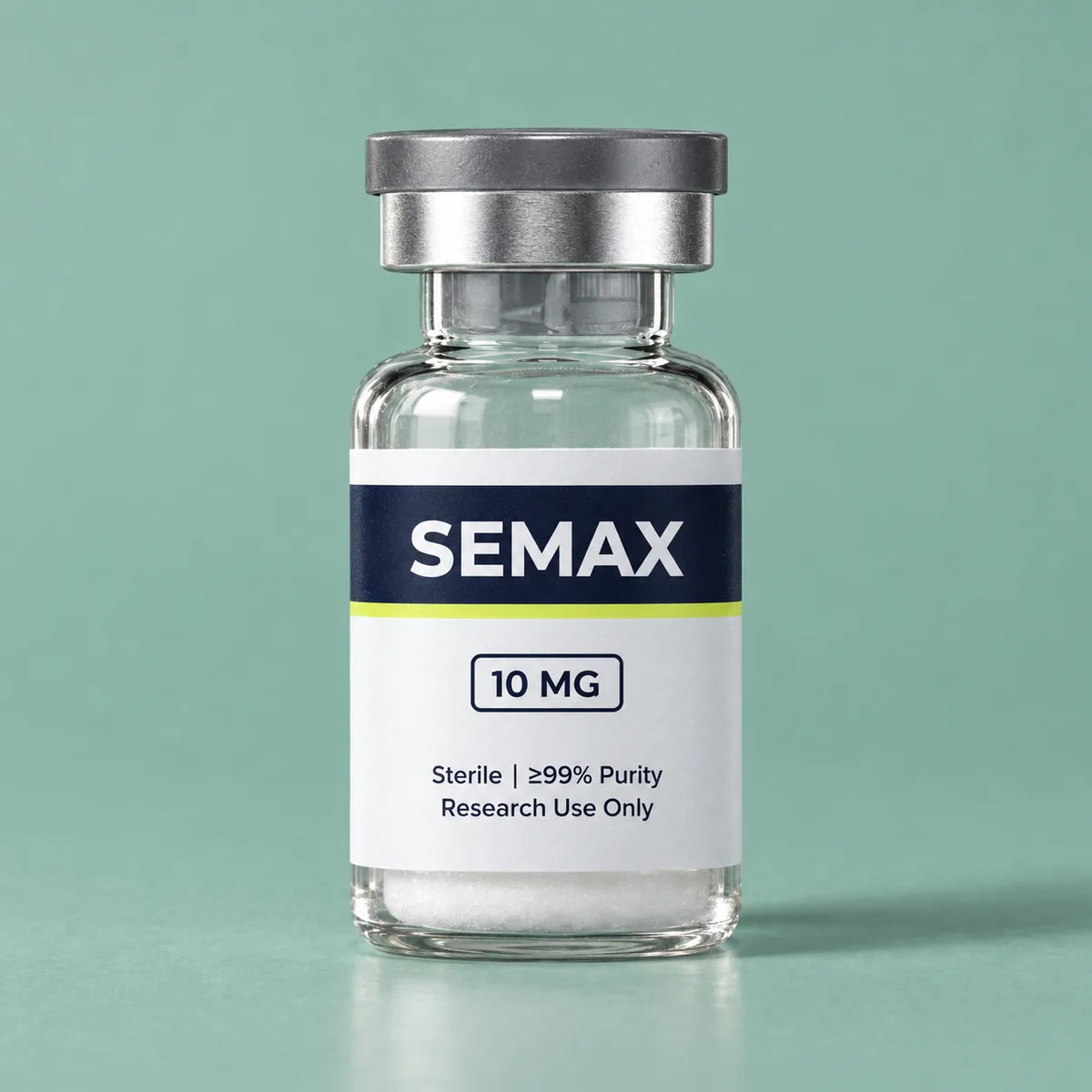
Semax is a synthetic analog of a short fragment of the hormone ACTH, developed in Russia and stripped of the hormonal activity the parent molecule has. It is approved and prescribed in Russia and Ukraine, mainly for stroke recovery and cognitive complaints, and it is usually given as nasal drops rather than an injection. Outside that region the picture changes completely: there are essentially no Western randomized trials, it is not FDA approved, and in the United States it is sold as a research compound. The reputation it has online as a focus aid for work or ADHD is built on personal reports, not on evidence.
What the research shows
- Clinical use in Russia and Ukraine — it holds regulatory approval there for stroke recovery and for cognitive and attention complaints, and the supporting literature is published largely in Russian journals. That is a real body of work, and it has not been reproduced under Western trial standards.
- The Western gap — there are essentially no randomized controlled trials in the United States or Europe. This is the single most important fact on the page, because a drug approved in one regulatory system and untested in another is not the same as a drug with broad evidence.
- Proposed mechanism — the working hypothesis involves effects on brain-derived neurotrophic factor and on the systems that regulate attention and stress. Mechanism work in animals and cells is a hypothesis about people, not a finding in people.
- Healthy users — the population that buys it online is not the population it was studied in. Evidence from stroke patients does not transfer to a healthy adult who wants a sharper afternoon.
- Focus and ADHD — interest here is entirely anecdotal. No controlled trial has tested Semax against a placebo for attention in people with ADHD.
Dosing in practice
A physician decides everything about dose and route. What follows describes how the compound is actually used where it is approved, so you can read a label rather than as a recommendation.
Semax is typically nasal, not injectable. In Russian practice it is supplied as drops or a spray in a low concentration solution, applied to each nostril one or more times a day, in short courses lasting days to a few weeks rather than continuous use. The intranasal route is the one with clinical precedent behind it, and injecting a nasal medicine is not a shortcut to a stronger effect. If you are working with reconstituted powder for any peptide, the arithmetic is where people go wrong, and it is worth checking before anything is drawn up.
Side effects and risks
- Reported in clinical use — nasal irritation, dryness and stinging are the common complaints, which is what an intranasal solution usually produces.
- Reported informally by users — headache, irritability, restlessness and trouble falling asleep when dosed late in the day. None of this comes from controlled Western monitoring.
- No Western safety dataset — the absence of trials means the absence of an independently reviewed adverse event profile, not a clean record.
- Product risk — vials and sprays sold online are unregulated, and independent testing of gray-market peptide products has repeatedly found wrong doses and impurities.
- The missed diagnosis — treating poor focus with an untested compound can delay a proper evaluation for ADHD, sleep disorder, depression or thyroid disease, all of which have real treatments.
Legal and FDA status
Semax is not FDA approved for any condition in the United States, and there is no lawful consumer product containing it. It is sold online labeled for research use, which is a disclaimer written to protect the seller. It is not a dietary ingredient either, so a supplement listing it is outside the rules. Approval in Russia and Ukraine carries no legal weight in the US market and does not make an imported spray a medicine here.
How people get it legally
The lawful supply route in the United States is narrow. No approved product exists, and Semax has not taken a recognized place in pharmacy compounding here. What stays legitimate is the first step, and it is the one that actually helps: a licensed physician who evaluates the complaint behind the search, whether that is fatigue, brain fog, poor attention or recovery after a neurological event, and treats it with something that has been tested. That visit is also how you find out whether a peptide belongs in the plan at all.
Questions people ask
What are the benefits of taking Semax?
Is Semax good for ADHD?
Is Semax a stimulant?
Who should not take Semax?
What is the best peptide for ADHD?
Sources: PubMed — Semax literature · PubMed — Semax in stroke · PubMed — ACTH fragment analogs and cognition · PubMed — ADHD treatment evidence