Not sure which peptide fits your goal? Take the 60 second match

Free tool

Peptide dosage
calculator.

Vial, water, target dose — exact syringe units. No signup, runs on your device. Or open the preset for your peptide.

5 units
Volume to draw0.05 ml
Concentration2500 mcg per ml
Vial lasts20 doses
Not sure this is the right peptide at all?Three questions, honest verdict, no email
Take the 60 second match
The Reconstitution Card, free PDFEight peptides, doses and units on one printable page — keep it next to the vials
Download the card
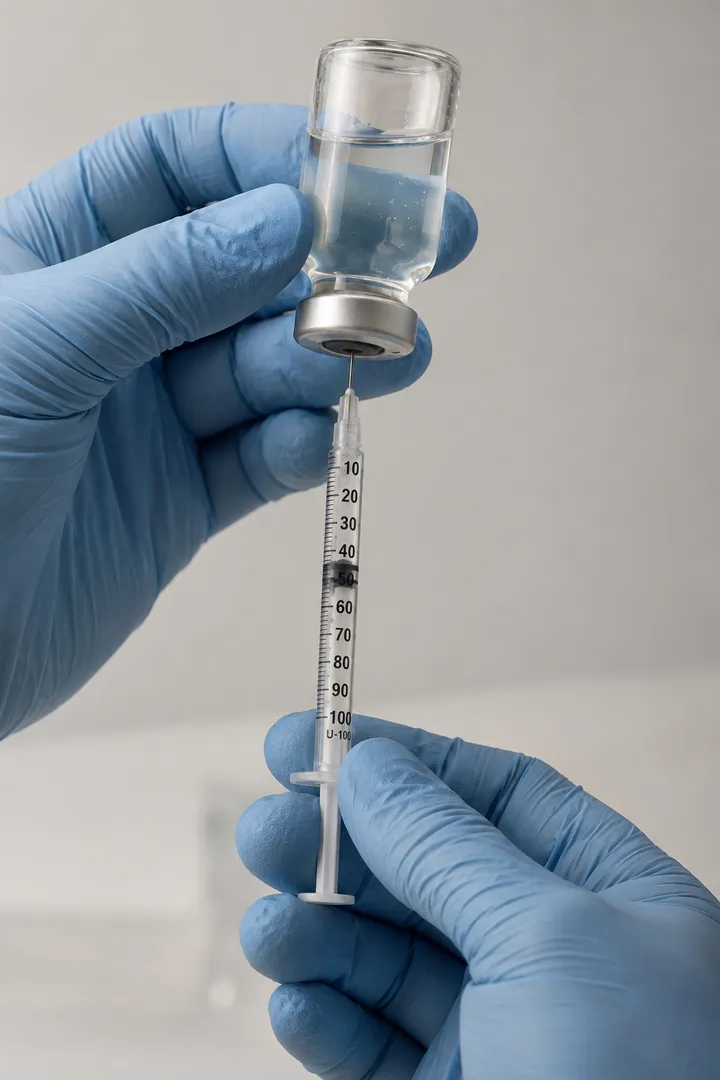
Drawing a peptide dose into an insulin syringe

How the math works

Reconstitution is one formula. The concentration of your vial is the peptide amount divided by the water you added. The volume you draw is your dose divided by that concentration.

On a U-100 insulin syringe, one full milliliter equals 100 units. So 0.1 ml is 10 units, 0.05 ml is 5 units. The calculator does this conversion for you.

Worked example

A 5 mg vial of BPC-157 with 2 ml of bacteriostatic water gives 2500 mcg per ml. A 250 mcg dose is 0.1 ml — 10 units on any insulin syringe. The vial holds 20 such doses.

A prescription peptide from a licensed pharmacy arrives with dosing set by your doctor. This tool is for understanding the math, not for choosing your own dose.

Common questions

How much water do you mix with peptides?
Common practice is 1 to 3 ml of bacteriostatic water per vial. More water means larger, easier-to-measure syringe volumes at the same dose; the total peptide in the vial is unchanged. Pick a volume that puts your dose between 5 and 50 units on your syringe.
What are common mistakes in peptide reconstitution?
Confusing mg with mcg is the big one — a thousandfold error. The others: using plain sterile water for multi-dose vials instead of bacteriostatic water, spraying water directly onto the lyophilized powder instead of down the vial wall, and shaking the vial instead of swirling it gently.
How do I reconstitute 30 mg of peptide?
The formula is identical at any size: 30 mg is 30 000 mcg. With 3 ml of water the concentration is 10 000 mcg per ml, so a 1 mg dose is 0.1 ml — 10 units on an insulin syringe. Enter 30 in the vial field above and the calculator adjusts everything.
Does the calculator work for tirzepatide and semaglutide?
The math is the same for any lyophilized compound measured in mg and dosed in mg or mcg. Note that FDA-approved GLP-1 medicines come in pre-filled pens with fixed dosing — you only reconstitute compounded versions, which your pharmacy will instruct you on.

Dosing is the easy part.

Whether a peptide is right for you at all is a physician's call. That consultation is cheaper than one wasted vial.

Talk to a doctor