Guide
Reconstitution,
done right.
Mixing a peptide vial is simple, and the few ways it goes wrong are worth knowing before the needle moves.
The short answer
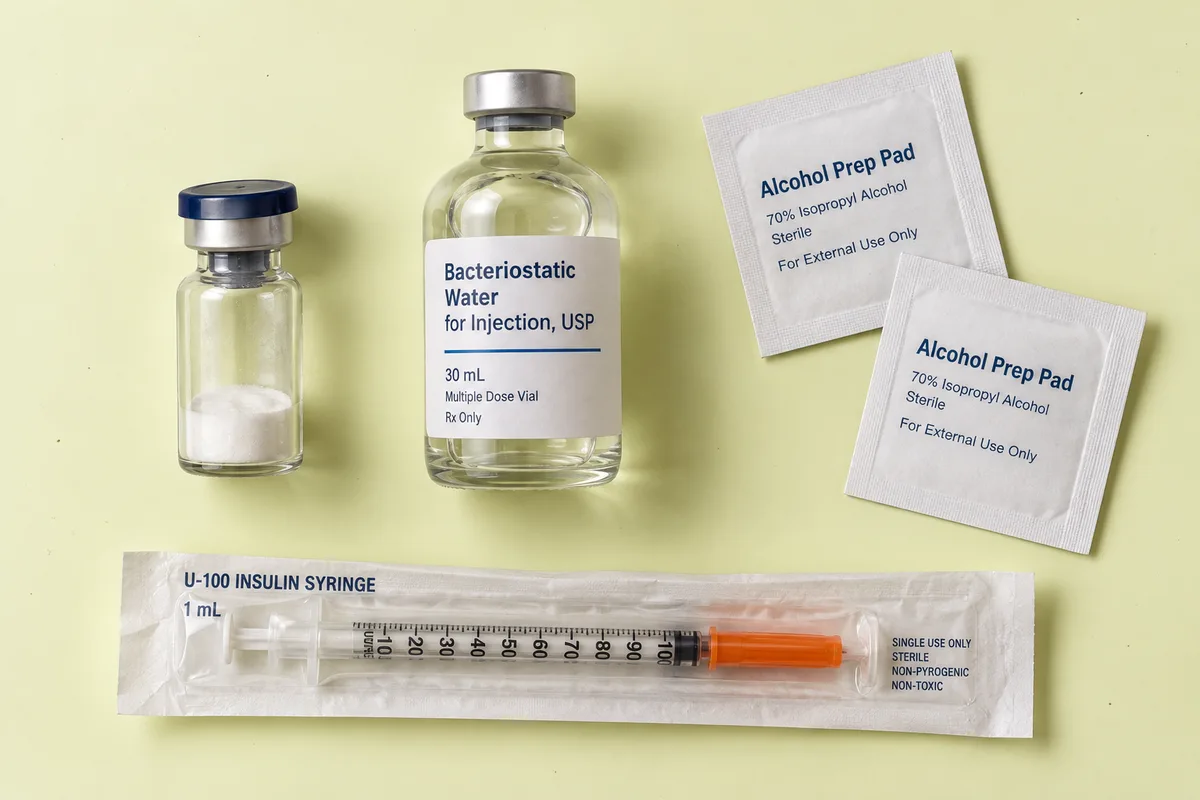
A peptide vial arrives as a freeze-dried cake of powder. Reconstitution means adding a measured volume of bacteriostatic water so the powder dissolves into a solution you can draw and dose. The volume you add is a choice, not a rule, because it decides the concentration. Everything else is clean technique: swab, pour down the glass, swirl, label, refrigerate.
What you need
- The peptide vial, still sealed, at room temperature
- Bacteriostatic water for injection
- An insulin syringe marked in units, plus a spare
- Alcohol pads, one per stopper, unopened
- A sharps container and a clean flat surface
- A fine marker and a label or tape for the date
Step by step
- Decide the volume first — look at your prescribed dose and choose the water volume that turns it into an easy number of syringe units. Doing this before you open anything prevents most dosing mistakes.
- Wash and swab — wash your hands, then wipe the rubber stopper of both vials with a fresh alcohol pad and let them air dry. Do not fan them or blow on them.
- Draw the water — pull your chosen volume of bacteriostatic water into the syringe and check the marking at eye level before you withdraw the needle.
- Run it down the wall — push the needle through the peptide stopper at an angle and let the water trickle slowly down the inside glass wall. A jet fired straight into the powder puts shear stress on a fragile molecule.
- Let it dissolve — most cakes clear on their own within a minute or two. If some powder clings, swirl the vial gently or roll it between your palms. Shaking foams the solution and can damage the peptide.
- Look before you trust it — the finished solution should be clear and free of particles. Cloudiness, floaters or color mean the vial does not get used.
- Label it — write the date of mixing and the concentration on the vial itself. Memory is not a labeling system, and a second vial in the same fridge is a real hazard.
- Refrigerate upright — store between 2 and 8 degrees Celsius, away from the freezer wall and out of light. Freezing a reconstituted peptide is the fastest way to waste it.
The milligram trap
One milligram is one thousand micrograms. Peptide vials are labeled in milligrams, most peptide protocols are written in micrograms, and insulin syringes are marked in units rather than either. Three units of measure in one small task is exactly the setup that produces a thousandfold error, and a thousandfold error is not a rounding problem.
How long it keeps
A properly mixed, refrigerated vial is generally treated as usable for about three to four weeks, and the labeling for bacteriostatic water allows 28 days of multi-dose use once the stopper has been punctured. Those numbers describe common practice and the preservative, not the stability of every individual peptide, which varies by molecule and by how the vial was handled. Shorter is always safer. Warmth, light, repeated trips in and out of the fridge and a stopper that has been punctured many times all shorten real life, and anything cloudy, discolored or past its written date goes in the sharps container rather than into your body.
Do the math once
The arithmetic behind concentration and syringe units is the part worth getting right on paper before it matters in the hand. Enter the vial strength, the water volume and the dose, and read the units back.
Questions people ask
How much water do you mix with peptides?
What are common mistakes in peptide reconstitution?
How to reconstitute 30 mg of peptides?
How long do reconstituted peptides last in the fridge?
Can you use plain sterile water instead of bacteriostatic water?
Sources: DailyMed — bacteriostatic water labeling · USP General Chapter 797 on sterile compounding · PubMed — peptide stability and storage