Peptide guide
Selank.
Calm, tested.
Russian trials suggest calm without sedation. Western trials have not been run at all. Both halves matter.
The short answer
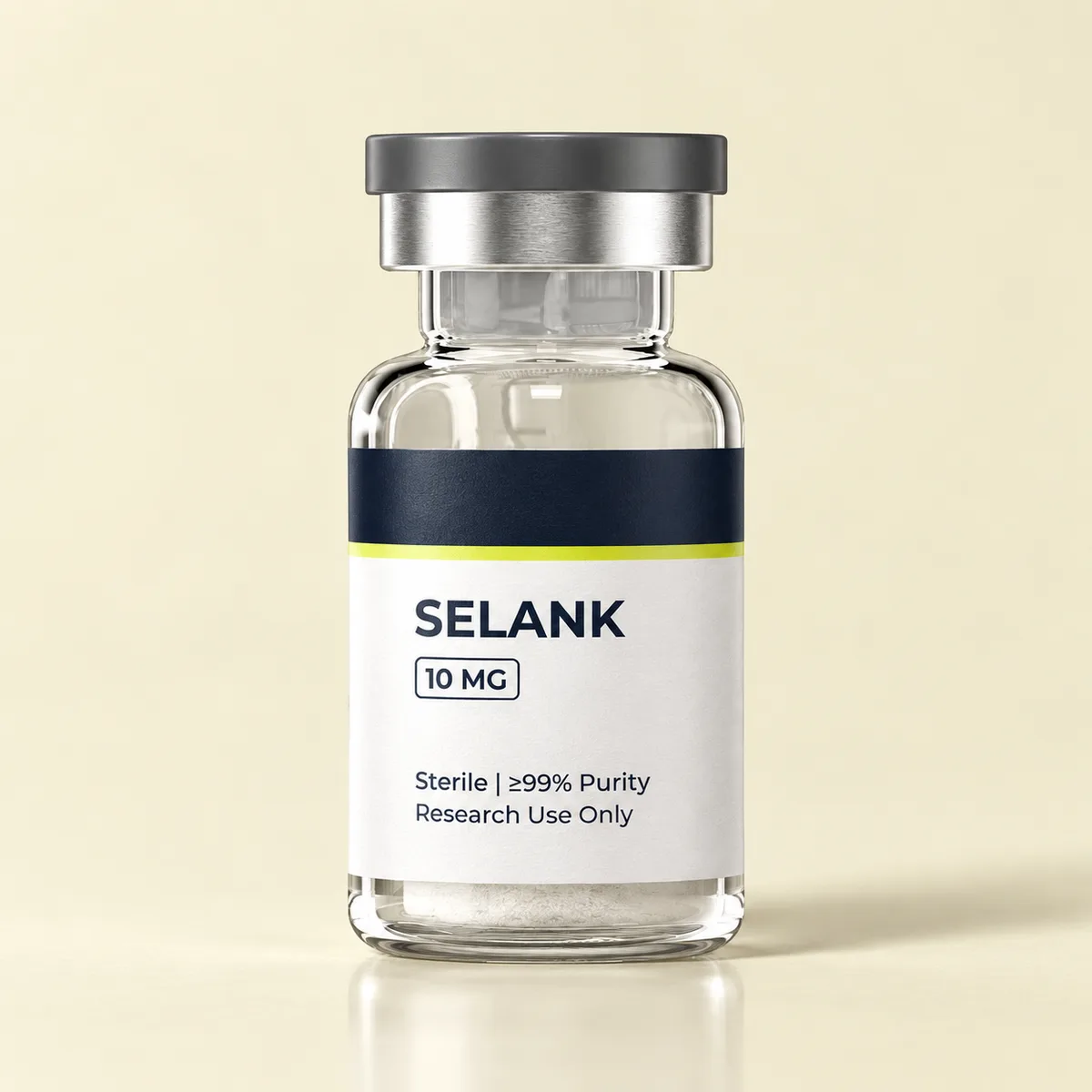
Selank is a synthetic analog of tuftsin, a short natural peptide, modified so it survives long enough to be useful. It was developed in Russia as an anxiolytic nasal spray, and the Russian clinical literature reports an anti-anxiety effect without the sedation, memory dulling and dependence associated with older anxiety medicines. That is the appeal. The counterweight is that no Western randomized trial has tested it, it is not FDA approved, and in the United States it holds research-compound status. It is usually discussed in the same breath as Semax, which came from the same research program.
What the research shows
- Russian clinical work — trials conducted in Russia report reduced anxiety in patients with anxiety and adjustment disorders, with the key selling point being that it did not sedate them or blunt attention the way benzodiazepines do.
- The Western gap — there are no randomized controlled trials in the United States or Europe. An effect reported in one regulatory system and never independently reproduced is a lead, not a conclusion.
- Proposed mechanism — hypotheses point toward effects on the GABA system and on the brain's serotonin and neurotrophic signaling, along with immune-related activity inherited from the tuftsin parent molecule. None of this is settled in humans.
- The dependence claim — absence of tolerance and withdrawal is the most repeated advantage, and it is also the claim that would need the longest study to verify. It has not had one outside Russia.
- Usually paired with Semax — the two came out of the same Russian research tradition and are often used together in practice there, which means much of the community discussion blends evidence for two different compounds.
Dosing in practice
A physician decides everything about dose and route. What follows describes how it is used where it is approved, written so you can read a label rather than as a recommendation.
Selank is typically nasal, not injectable. Like Semax, it is supplied in Russian practice as a low concentration solution given as drops or a spray into each nostril, one or more times a day, in short courses lasting days to a few weeks rather than as continuous therapy. The intranasal route is the one with clinical precedent, and injecting a nasal medicine does not make it work better. If you are handling reconstituted peptide powder for anything, the arithmetic is where people make dangerous mistakes, so check it before drawing up.
Side effects and risks
- Reported in clinical use — nasal irritation, dryness and a burning sensation in the nostril, which is typical of any intranasal solution.
- Reported informally by users — mild drowsiness in some, mild restlessness in others, headache, and a flat or blunted mood at higher frequencies of use. None of this comes from controlled Western monitoring.
- No Western safety dataset — without trials there is no independently reviewed adverse event profile, and that is not the same thing as a clean record.
- Product risk — sprays and vials sold online are unregulated, and independent testing of gray-market peptide products has repeatedly found wrong doses and impurities.
- The missed diagnosis — untreated anxiety disorders respond well to treatments that have been tested for decades, and self-medicating with an unapproved compound can postpone that care for a long time.
Legal and FDA status
Selank is not FDA approved for any condition in the United States, and no lawful consumer product contains it. What is sold online carries a research use only label, which is a disclaimer written for the seller rather than a quality guarantee for the buyer. It is not a lawful dietary ingredient either. Its approval status in Russia has no bearing on US law and does not turn an imported spray into a medicine here.
How people get it legally
The lawful route in the United States is narrow. No approved product exists and Selank has not taken a recognized place in pharmacy compounding here. What stays legitimate is the first step: a licensed physician who evaluates the anxiety itself, rules out the medical causes that mimic it, explains which treatments have evidence behind them, and decides what belongs in your plan. Anxiety is one of the best-treated conditions in medicine, and that makes gambling on an untested compound a worse trade than it looks.
Questions people ask
What does Selank do?
Does Selank work for anxiety?
Is Selank addictive?
What is the difference between Selank and Semax?
Is Selank legal to buy in the US?
Sources: PubMed — Selank literature · PubMed — Selank and anxiety · PubMed — tuftsin analogs · PubMed — anxiety treatment evidence