Peptide guide
KPV.
The gut peptide.
Three amino acids with a real anti-inflammatory story in the lab and no human trial behind any of it.
The short answer
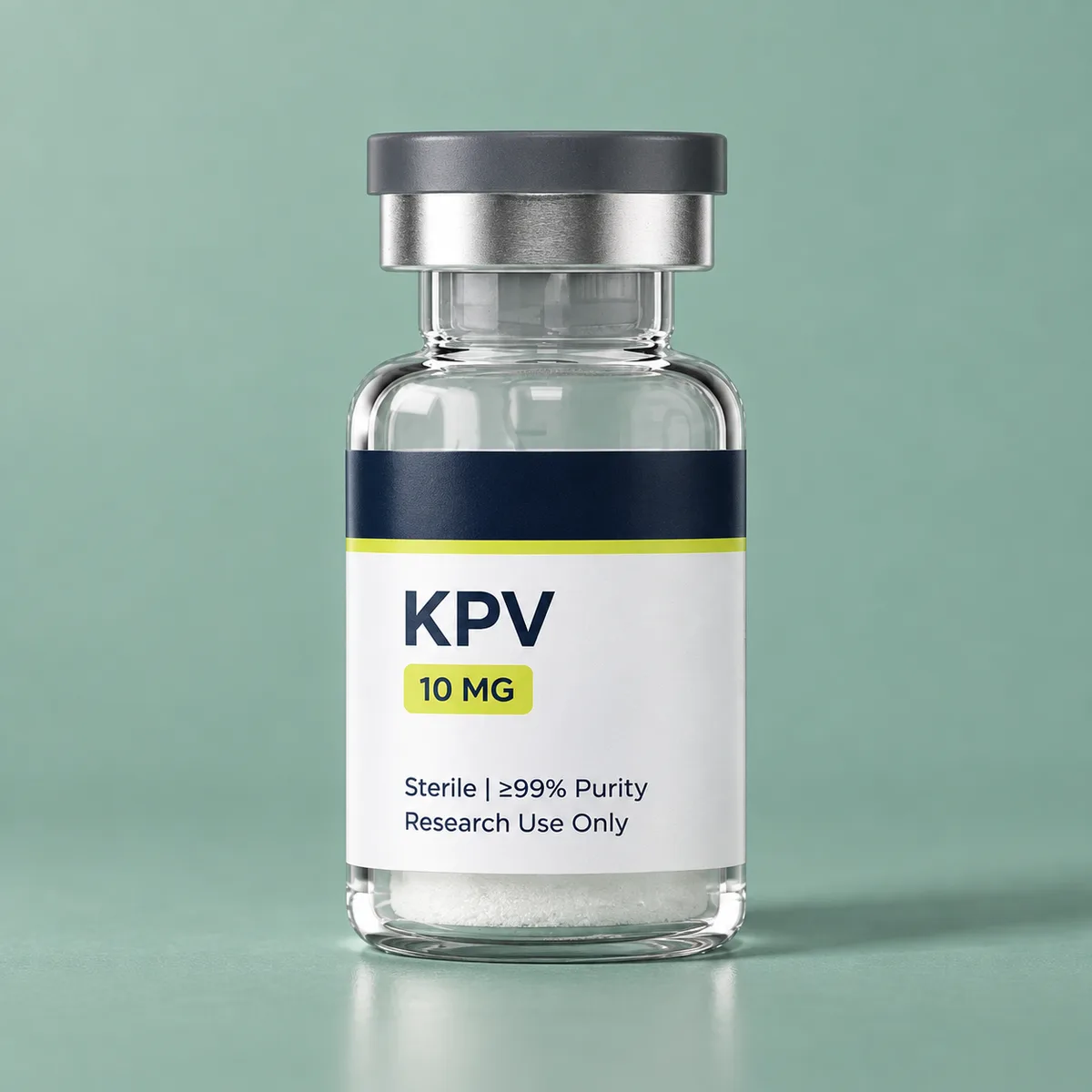
KPV is the tail end of a hormone your body already makes. Alpha-melanocyte stimulating hormone carries well documented anti-inflammatory activity, and KPV is its final three amino acids, lysine, proline and valine, studied to see how much of that activity survives in the smallest possible fragment. In cell cultures and in rodent models the answer has been encouraging, especially in models of inflammatory bowel disease and in irritated skin. In humans nothing has been measured. There is no completed published trial, no approved product, and everything sold today carries a research use only label.
What the research shows
- Where it comes from — alpha-MSH is a natural signaling hormone with a long research record for damping inflammation. KPV is its C-terminal tripeptide, and the interest in it began with the finding that the short fragment keeps anti-inflammatory activity without the pigment signaling of the full hormone.
- Gut models — the largest body of work uses mouse models of colitis, where published studies report reduced inflammation in the colon. A related line of research has focused on carriers that deliver the tripeptide to the intestinal lining rather than into the bloodstream.
- Proposed mechanism — laboratory work describes the peptide entering cells and interfering with inflammatory signaling from the inside, including the NF-kB pathway, rather than blocking a receptor on the cell surface. Uptake through an intestinal peptide transporter is the reason oral dosing is even discussed.
- Skin work — alpha-MSH fragments have been reported in laboratory studies to calm inflammatory responses in skin cells and to show some antimicrobial activity. That is the basis for the creams, and it is a long way from a dermatology trial.
- Human evidence — none. No completed randomized trial reports efficacy or safety of KPV in people for gut disease, skin disease or anything else. Everything circulating online is extrapolation from animals or personal anecdote.
KPV with BPC-157
Gut protocols sold online almost always pair the two, and the reasoning is that they are described as doing different jobs. BPC-157 has three decades of rodent work on repairing gut tissue and promoting new blood vessels. KPV has laboratory work on quieting the inflammatory signal that damaged the tissue in the first place. On paper the pairing looks complementary, which is exactly why it sells.
Here is what that argument leaves out. Neither compound has a completed human trial alone, so there is no trial of the combination, no interaction data and no safety monitoring in any population. Combining two unstudied compounds does not average their uncertainty, it stacks two unregulated vials in the same body. If the underlying problem is real inflammatory bowel disease, it is also worth knowing that this condition has approved treatments with large randomized trials behind them, which no peptide protocol can claim.
Dosing in practice
A physician decides whether anything belongs in your plan and at what dose. What follows describes what appears on labels and in reported practice, so the units make sense when you read them.
Oral capsules are the most common form and are usually labeled in the range of 250 to 500 micrograms daily, often taken away from food. Topical creams list the peptide at low concentrations for use on a small area. Injectable vials arrive as freeze-dried powder that has to be reconstituted with bacteriostatic water, and microgram doses translate into very small syringe markings, which is where the serious mistakes happen. None of these forms has a dose established by a human study, so every number in circulation is convention rather than evidence.
Side effects and risks
- No controlled human safety data exists, so there is no list of expected effects to quote, only what users describe.
- Reported informally — mild stomach upset and loose stools with oral capsules, headache, and redness at an injection site.
- Skin products can irritate, and a new topical on inflamed skin deserves a small test area first.
- Pigment change is not an expected effect, since the fragment lacks the part of alpha-MSH that drives tanning. That is reasoning from structure, not a safety finding.
- Immune signaling is the open question. A compound that quiets inflammation is being used without any measurement of what else it quiets, and that matters most for anyone with an infection or on immune-modifying medicine.
- Product risk — independent testing of gray-market peptide vials has repeatedly found wrong doses, impurities and contamination. That is the concrete hazard here, not the molecule.
Legal and FDA status
KPV is not an approved drug in the United States and no approved product contains it for any condition. It is sold as a research compound in capsules, creams and vials, and the research use only label on those products is a statement of the seller's legal position rather than a standard of quality, identity or sterility. Capsules marketed as supplements sit in the same gray zone as other peptides the FDA has addressed, and none of them has been reviewed for this use.
How people get it legally
There is no lawful prescription route to KPV, so the honest version of this section is about the symptom rather than the compound. Persistent diarrhea, blood in the stool, abdominal pain or unexplained weight loss need a diagnosis before they need a protocol, because inflammatory bowel disease, celiac disease and infection look similar from the outside and are treated very differently. A licensed physician can order the right workup, name what is actually happening, and offer treatments with human trial evidence behind them. Skin complaints follow the same logic through a dermatologist. Starting there costs you a few weeks and can save you years.
Questions people ask
What are the benefits of KPV peptide?
What is the difference between KPV and BPC?
Who should not use KPV peptide?
Is it better to take KPV in the morning or at night?
Does KPV help with weight loss?
Sources: PubMed — KPV literature · PubMed — alpha-MSH anti-inflammatory research · ClinicalTrials.gov — KPV trial search · FDA — dietary supplement ingredient directory