Peptide guide
Epitalon.
The long bet.
Decades of Russian aging research, no Western replication, and no approval anywhere. Here is what that is worth.
The short answer
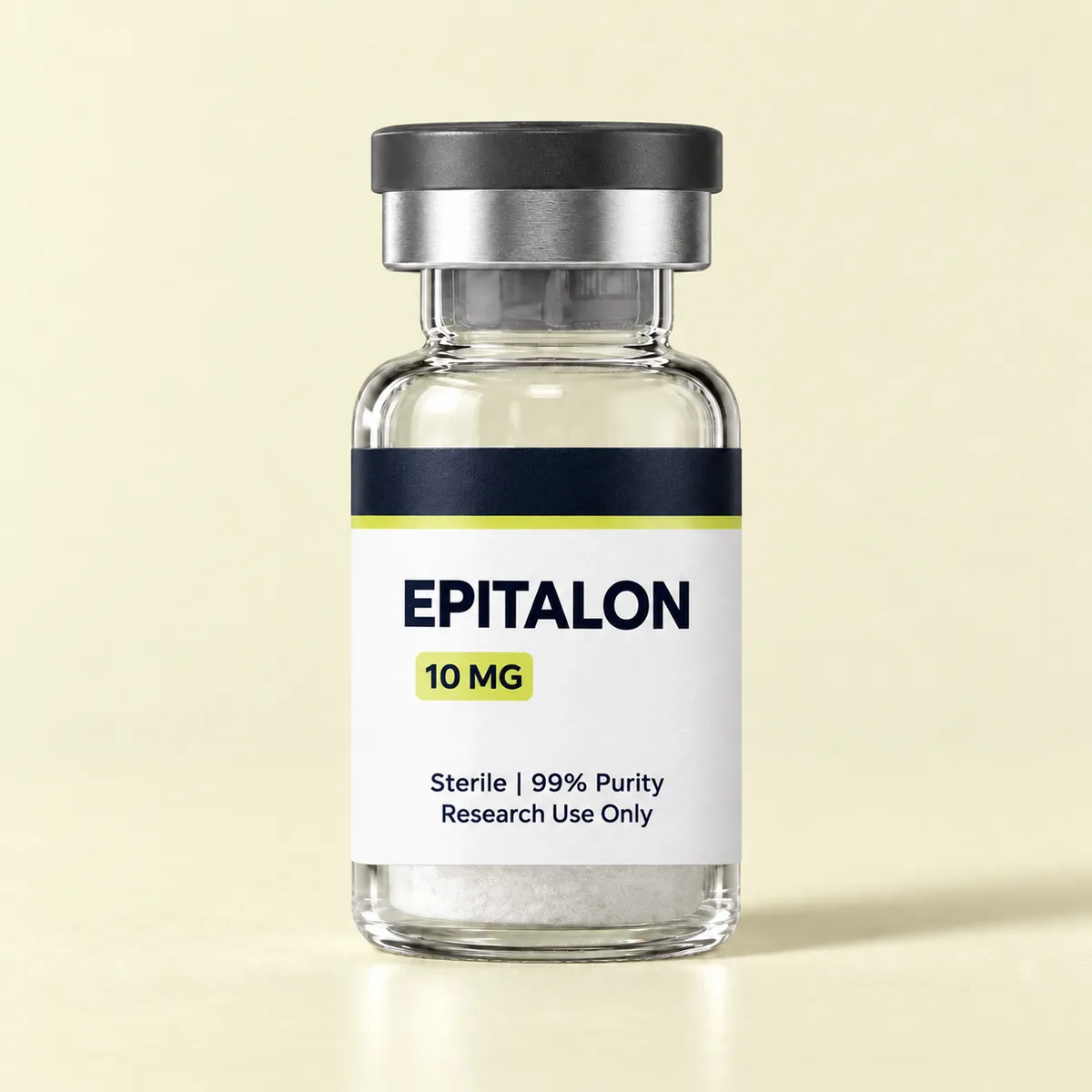
Epitalon is a synthetic four amino acid peptide built to reproduce the active part of epithalamin, an extract of the pineal gland. It came out of the school of gerontology led by Vladimir Khavinson in St Petersburg, which has spent decades arguing that short peptides act as regulators of aging. Their published work reports telomerase activation in cell cultures, restored melatonin rhythm and effects on lifespan in animals and in elderly patients. Almost all of it comes from that one lineage of researchers, much of it is old, and none of it has been replicated in an independent Western randomized trial. There is no approval anywhere in the world. That combination makes epitalon the most interesting unproven molecule in this catalog and, taken honestly, a bet that Russian gerontology turns out to be right.
What the research shows
- Where it comes from — epithalamin is a peptide preparation from the pineal gland studied in the Soviet Union from the 1970s onward. Epitalon is the synthetic sequence designed to carry the same activity in a defined, reproducible molecule.
- The telomerase claim — the developing group reported that treated human somatic cell cultures showed telomerase activity and extended division, which is the origin of everything written online about telomeres. This is laboratory work in cells, not an outcome measured in a treated person.
- The pineal claim — the broader theory is that the aging pineal gland loses its rhythm and that the peptide restores melatonin signaling and the hormonal cycles tied to it. Animal work from the same tradition reports effects on tumor incidence and on lifespan in rodents.
- Human observations — long-running Russian follow-up of elderly patients has been published with claims of improved markers and reduced mortality. These reports are small, largely from one institute, and not structured the way a modern registration trial would be.
- What is missing — an independent randomized placebo-controlled trial with preregistered endpoints, published in full outside that research tradition. Until one exists, the claims stay claims.
The replication problem
Concentration of evidence in one research group is the central issue on this page, and it is worth stating without hostility. Long-lived, internally consistent research programs have been right before, and dismissing Soviet and Russian science by default is its own kind of sloppiness. The problem is structural rather than national: when one team generates the hypothesis, the model, the compound and the outcome data across decades, the usual error-correcting machinery of science never runs. Western groups have not picked up the work in a serious way, so the findings have never been stress-tested by people with nothing invested in them.
The second complication is the endpoint. Aging research is expensive precisely because the outcome that matters takes a lifetime to measure, so it attracts surrogate markers that look scientific and predict very little. Telomere length is the clearest example. It correlates with age, it is easy to measure, and no one has shown that pushing it in one direction extends a human life. A compound can be doing exactly what its developers say at the cellular level and still do nothing you would notice.
Dosing in practice
A physician decides whether anything belongs in your plan and at what dose. What follows describes what appears in the published protocols and in reported practice, so the units make sense when you read them, not as a recommendation.
The convention that longevity users follow comes straight from the Russian protocols: short courses rather than continuous use, typically 5 to 10 milligrams daily by subcutaneous injection for ten to twenty days, repeated once or twice a year. Intranasal preparations appear at lower labeled amounts. Vials arrive as freeze-dried powder that must be reconstituted with bacteriostatic water before use. Note what the course structure implies. It was designed around a theory of periodic regulation, not around a measured dose response in people, so the numbers are inherited convention rather than established dosing.
Side effects and risks
- Reported tolerability is good. Decades of described clinical use in Russia and short courses in practice have not produced a signal of acute toxicity in the published record.
- That record is thin by Western standards. Good tolerability reported informally, by the same people reporting the benefits, is not a monitored safety dataset.
- Users describe sleepiness, vivid dreams and shifted sleep timing, which is unsurprising for a compound aimed at the melatonin system, along with injection site redness.
- Telomerase activation cuts both ways in theory. The same mechanism that keeps healthy cells dividing is one that cancer cells exploit, which is why anyone with an active or recent malignancy should not be experimenting here.
- Product risk — independent testing of gray-market peptide vials has repeatedly found wrong doses, impurities and contamination. With a four amino acid peptide that is cheap to fake, this matters as much as the molecule.
Legal and FDA status
Epitalon is not an approved drug in the United States and it holds no marketing approval in Europe. In Russia the related peptide preparations have a regulatory history of their own, and that history does not transfer across borders or serve as evidence for a US buyer. Everything sold here is labeled for research use, which is a statement about the seller's legal exposure rather than a standard of purity, identity or sterility, and nothing in that label implies a review of the compound for human use.
How people get it legally
There is no lawful prescription route to epitalon in the United States, so the practical question is what you are actually trying to fix. If the answer is sleep, energy, a family history you are worried about, or markers that moved in the wrong direction on your last panel, those are all things a licensed physician can measure and address with treatments that have been tested. If the answer is that aging itself is the target, be clear with yourself that you are making a bet on an unreplicated research tradition, and make it with money you can afford to lose and a doctor who knows you are doing it.
Questions people ask
What does epitalon do?
Does epitalon really lengthen telomeres?
Is epitalon safe?
How is epitalon typically dosed?
Is there any Western research on epitalon?
Sources: PubMed — epitalon literature · PubMed — Khavinson peptide research · ClinicalTrials.gov — epitalon trial search · FDA — dietary supplement ingredient directory