Longevity guide
NAD+.
The hype check.
Blood levels really do rise. No trial shows that healthy people age slower or feel better. Here is the gap.
The short answer
NAD+ is a coenzyme, not a true peptide. Every cell in the body already uses it for energy metabolism and DNA repair, and levels decline with age, which is where the longevity story starts. It is sold and injected alongside peptides almost everywhere peptides are sold, and it is one of the most searched compounds in the longevity space at roughly 27,000 US searches a month. Small pharmacokinetic studies show that subcutaneous and intravenous dosing raise blood NAD levels. No outcome trial shows anti-aging or energy benefits in healthy people. Those two sentences are the whole honest summary.
What the research shows
- It reaches the blood — small pharmacokinetic studies confirm that intravenous and subcutaneous NAD raise circulating levels and the related metabolites. That is a measurement of delivery, not a measurement of benefit.
- The aging hypothesis — NAD levels fall with age in laboratory models, and restoring them improves markers in cells and in mice. The leap from mouse markers to a human feeling younger is exactly the leap that has not been tested.
- Healthy people — no completed trial reports that NAD dosing improves energy, cognition, endurance or lifespan in healthy adults. The claims on clinic menus run far ahead of the published record.
- Oral precursors are a separate question — nicotinamide riboside and related precursors have their own small human studies, and they mostly show the same pattern: levels move, outcomes do not clearly follow.
- Why the drip feels like something — a two hour infusion with fluids, rest and strong physiologic sensation is hard to blind, so subjective reports from clinics carry very little evidentiary weight.
Dosing in practice
A physician decides whether any of this belongs in your plan and at what dose. What follows describes what appears on clinic protocols so you can read a menu, not a recommendation.
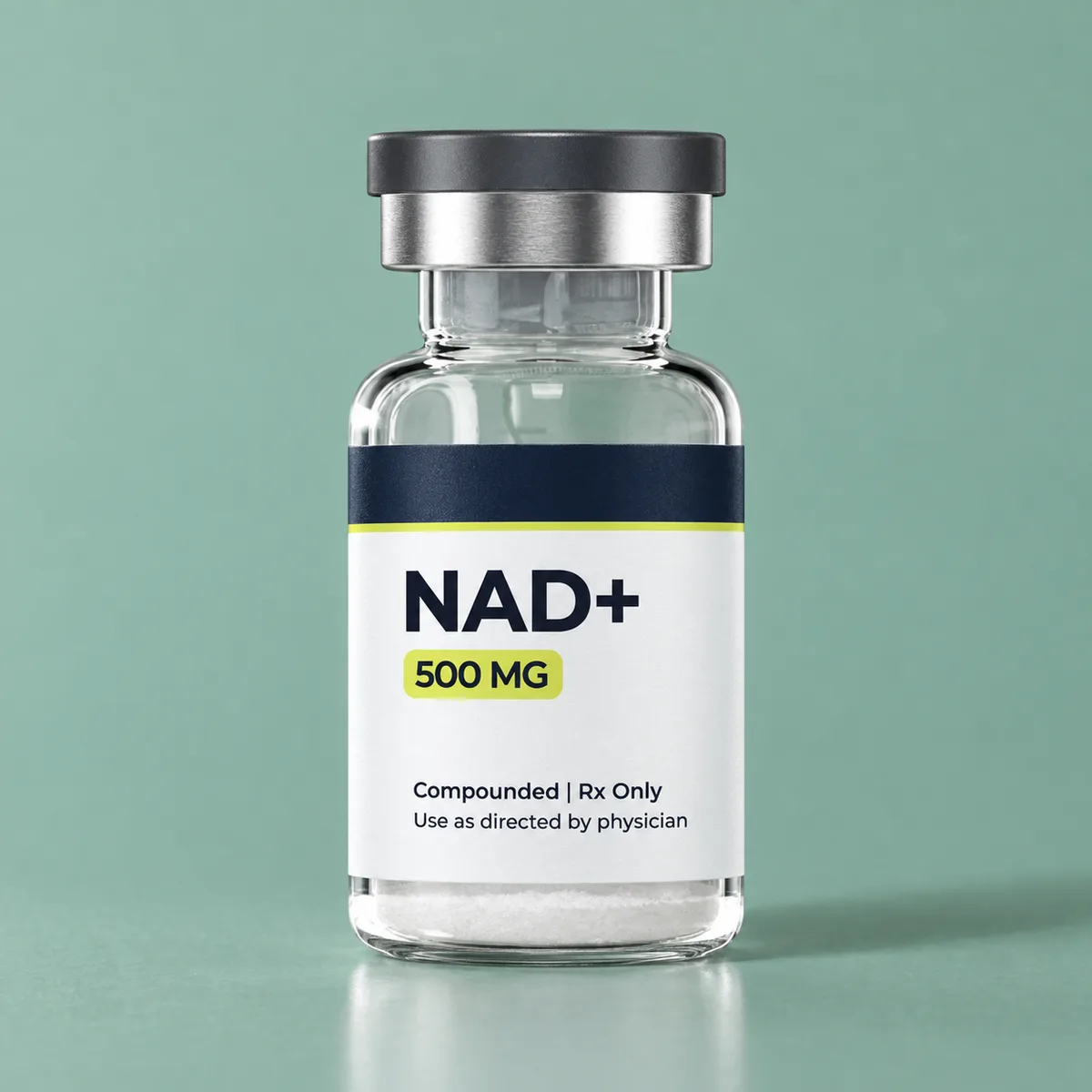
Intravenous programs in longevity clinics commonly run from a few hundred milligrams up to about 1,000 milligrams per infusion, delivered slowly over two to four hours because speed is what causes the unpleasant part. Subcutaneous vials arrive as a freeze-dried powder that must be reconstituted with bacteriostatic water, and reported doses are much smaller, often in the 50 to 100 milligram range, several times a week. The recurring error is the same one that sends peptide users to urgent care: mixing up milligrams and milliliters while drawing up insulin syringe units.
Side effects and risks
- Infusion reactions — fast intravenous delivery reliably causes flushing, nausea, abdominal cramping and chest tightness. Slowing the drip is the standard fix, which is why a one hour NAD drip is a bad sign rather than a convenience.
- Subcutaneous is gentler — the same dose spread under the skin avoids most of the infusion reaction, at the cost of injection site redness and soreness.
- Unknown long-term profile — nobody has followed people on repeated high-dose NAD for years, so late effects are unmeasured rather than ruled out.
- Cost — a course of infusions runs into four figures quickly, and it is being spent on an outcome that has not been demonstrated.
- Product risk — compounded and gray-market vials vary in purity and strength, and an unsterile injected product is a real hazard regardless of what the label says.
Legal and FDA status
NAD+ is not an FDA approved drug for any condition. It sits in the compounding lane: licensed pharmacies prepare it, physicians prescribe it, and telehealth clinics make it easy to obtain. That makes it lawful to dispense in a way many research peptides are not, and it says nothing at all about whether it works. Availability and evidence are separate axes, and NAD scores high on one and low on the other.
How people get it legally
The lawful route is ordinary and short. A licensed physician reviews your history, your labs and what you are actually trying to fix, tells you whether the evidence supports the attempt, and sends a prescription to a licensed US compounding pharmacy that ships a sterile, documented vial or schedules the infusion. If fatigue is the complaint, that same visit is the one that checks thyroid, iron, sleep apnea and the other things that make people tired for reasons a drip will not touch.
Questions people ask
What does the NAD injection do?
Does NAD+ really work?
What is the downside of taking NAD?
Is NAD just vitamin B12?
Does NAD help with belly fat?
Sources: PubMed — intravenous NAD pharmacokinetics · PubMed — NAD precursor trials · PubMed — NAD and aging biology · FDA — bulk substances for compounding