Supplement guide
Collagen
peptides, really.
The most searched peptide word in the country, and the only one on this site you can buy in a grocery store.
The short answer
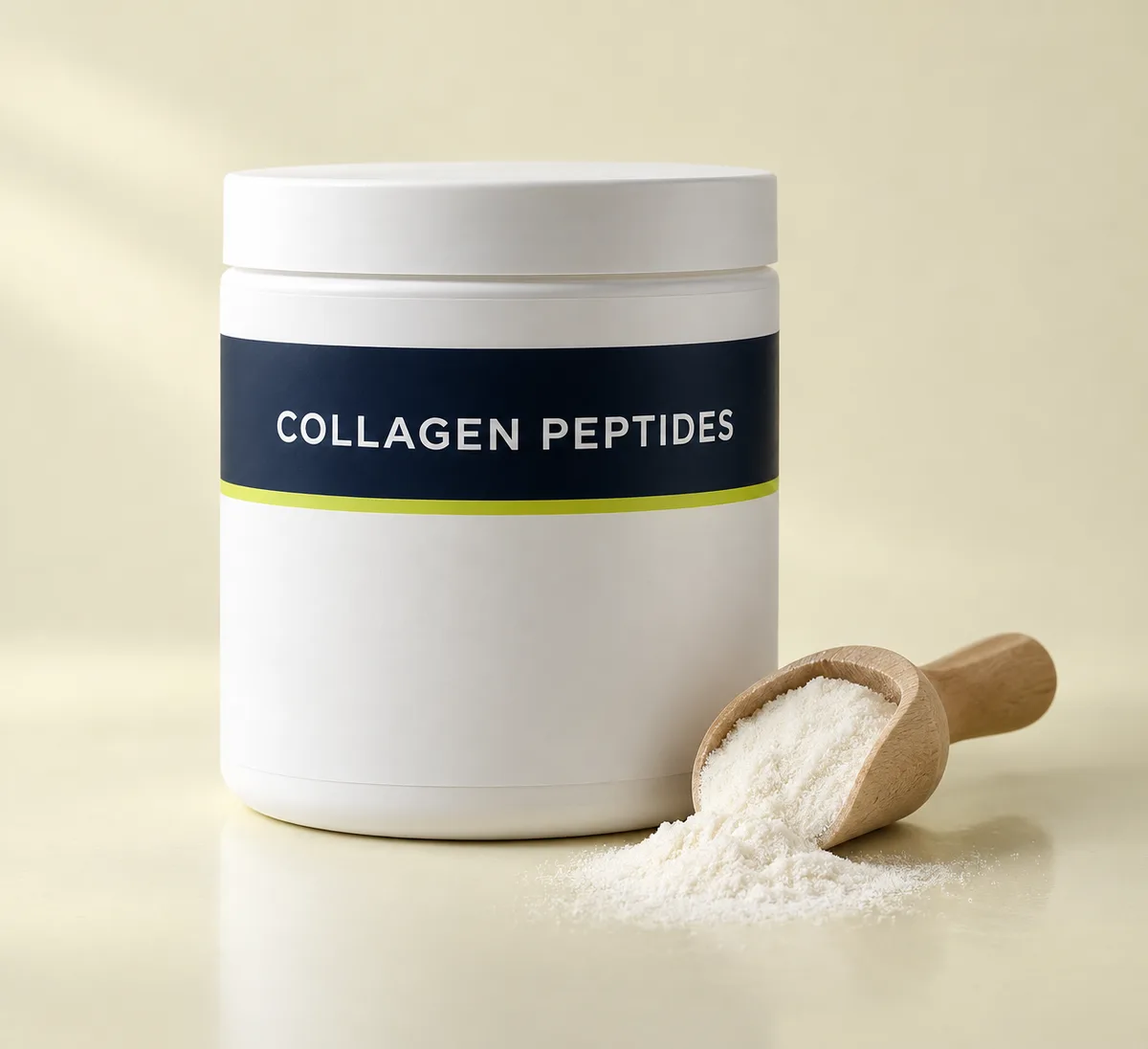
Collagen peptides are hydrolyzed collagen, a food protein sold as a powder. They are not injected, they need no prescription, and they belong to a completely different category from every other compound on this site. The evidence is better than the skeptics say and far smaller than the packaging implies: randomized trials report modest improvements in skin hydration and elasticity at 2.5 to 10 grams daily over 8 to 12 weeks, with a second body of work on joint comfort in athletes. That is the honest size of the claim.
What the trials show
- Skin hydration and elasticity — the strongest and most repeated finding. Randomized, placebo-controlled studies using 2.5 to 10 grams daily for 8 to 12 weeks have reported measurable gains in skin moisture and elasticity against placebo. The differences are real, they are small, and they show up on instruments before they show up in a mirror.
- Joint comfort in athletes — a separate line of work in active adults and athletes with activity-related joint pain has reported reduced discomfort during exercise over similar timeframes. These trials measured how joints feel, not how cartilage looks on imaging.
- Study quality is the catch — a large share of this literature is funded by the companies that sell the ingredient, sample sizes are small, and outcomes are subjective in the joint studies. Industry funding does not make a result false, but it does mean independent replication carries more weight than a press release.
- Nails and hair — weaker and thinner, mostly small studies with self-reported outcomes. Treat any confident claim here as marketing ahead of data.
- It stops when you stop — no trial has shown a lasting effect after daily intake ends. This is a habit, not a course of treatment.
What it does not do
Swallowed collagen does not travel to your face and become collagen there. Digestion breaks the protein into amino acids and short di-peptides and tri-peptides, and your body then uses those building blocks wherever it decides to use them. Any benefit almost certainly comes from a signaling effect of certain absorbed fragments and from simply supplying glycine and proline, not from delivering collagen to a wrinkle.
Which leads to the uncomfortable comparison. Gram for gram, collagen is an incomplete protein — low in several essential amino acids. If your total daily protein is already adequate, the extra scoop is doing less than the label suggests. If your protein intake is low, almost any protein source would help, and collagen is the expensive way to get there.
Not the peptides here
The word peptide is doing two unrelated jobs. On the rest of this site it means a defined sequence of amino acids, made in a lab, injected in microgram or milligram doses, with a regulatory status that ranges from FDA approved to explicitly flagged. Collagen peptides are an unspecified mixture of fragments from animal connective tissue, eaten by the gram, regulated as food.
That distinction matters when you shop. A vendor that sells collagen powder alongside research vials is blurring two categories with completely different safety and legal profiles, and the reassuring facts about the powder transfer to none of the vials.
The vegan problem
Collagen is an animal protein. It exists in skin, bone, scale and connective tissue, and there is no plant that makes it. So a vegan collagen supplement is either a marketing name for something else entirely — usually a blend of vitamin C, amino acids and botanicals meant to support your own collagen production — or it is a genuinely different product made by engineered yeast or bacteria, which is a real technology and a rare, expensive one.
Neither is hydrolyzed bovine or marine collagen, and neither has the trial record described above. Read the ingredient panel, not the front of the tub.
How to pick a powder
- Hydrolyzed, always. Look for hydrolyzed collagen or collagen peptides on the panel. Unhydrolyzed gelatin is the same protein without the processing that makes it dissolve and absorb.
- A dose you can reach. Trials used 2.5 to 10 grams daily. Check what one serving actually delivers rather than what the tub claims across the month.
- Third-party tested. Supplements are not pre-approved by the FDA, so an independent certification mark is the only outside check on identity, dose and heavy metals. Marine and bovine sources both concentrate what the animal was exposed to.
- Short ingredient list. Proprietary blends hide how much collagen you are buying behind a single combined weight.
- Ignore the type numbers. Type I, II and III labeling sells well, and no human trial shows one type outperforming another for skin once it is hydrolyzed and digested.
Who should skip it
Almost nobody needs to avoid collagen peptides on safety grounds. It is a food protein, side effects in trials were minimal and mostly digestive, and there is no meaningful interaction profile. The sensible exceptions are an allergy to the source animal, fish or shellfish sensitivity with marine collagen, and any advice your own clinician has given you about protein intake with kidney disease. Pregnancy and breastfeeding are worth a quick word with your doctor simply because supplement quality is uneven.
The better reason to skip it is money. If you are already eating enough protein and want visible skin change, retinoids, sunscreen and sleep have far more human data behind them than any scoop.
Questions people ask
Do collagen peptides really work?
What is the difference between collagen and collagen peptides?
How long until collagen peptides show results?
Can vegans take collagen peptides?
Do collagen peptides help joints?
Sources: PubMed — collagen peptides and skin · PubMed — collagen peptides and joint pain · FDA — dietary supplement ingredient directory