Guide
Bacteriostatic
water.
Sterile water with one added ingredient, and that ingredient is the whole reason a vial can be used more than once.
The short answer
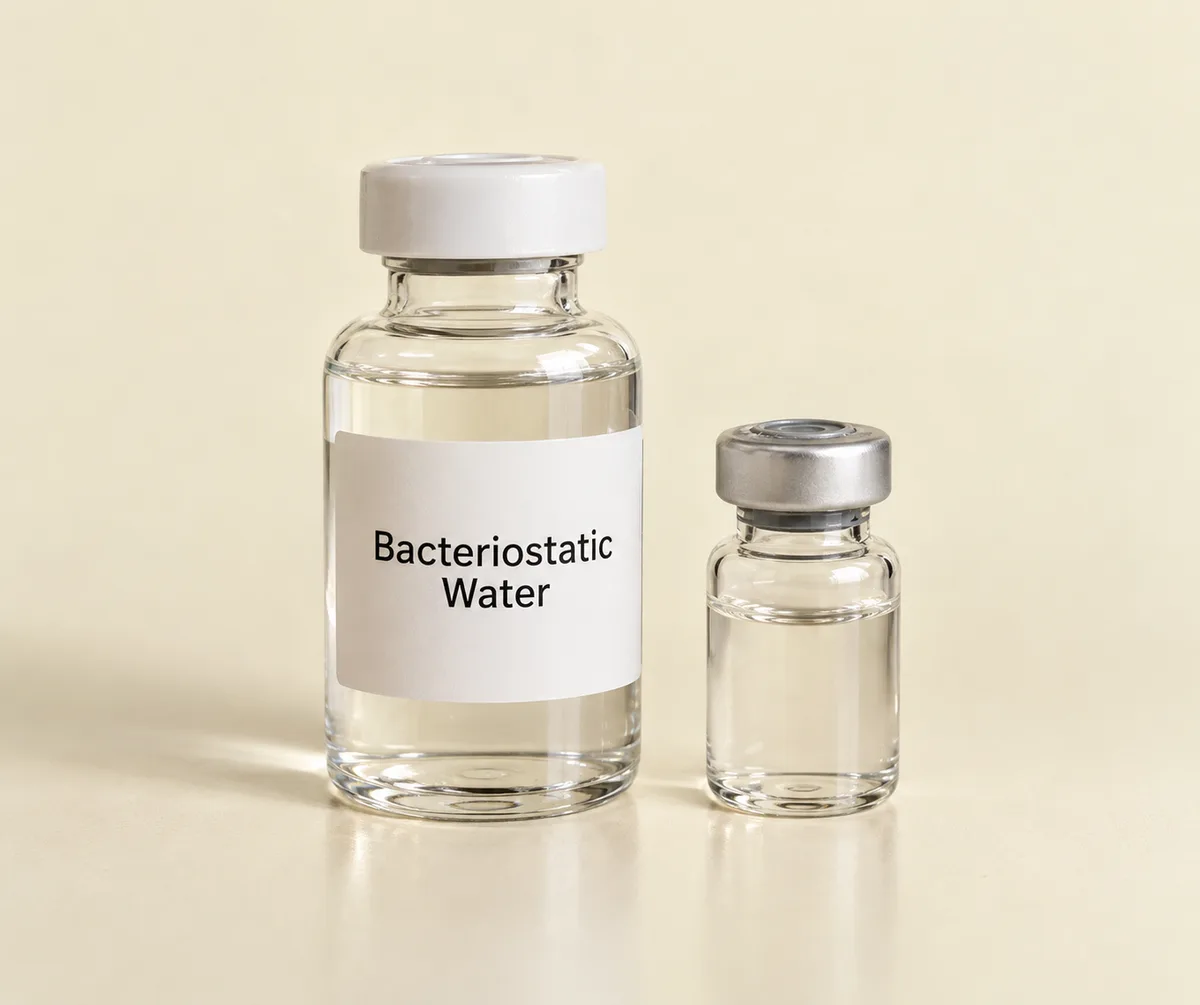
Bacteriostatic water for injection is sterile water that contains 0.9 percent benzyl alcohol as a preservative. The benzyl alcohol does not sterilize anything. It holds back the growth of bacteria that might be introduced when a needle passes through the stopper, which is what allows the same vial to be entered repeatedly over several weeks. That is the entire difference between it and ordinary sterile water, and it is the reason peptide vials are reconstituted with it.
Why the preservative
Every puncture of a rubber stopper is an opportunity for skin bacteria to ride the needle into the vial. In a single-use product that risk is handled by using the contents once and discarding the rest. In a vial that will be entered a dozen times over a month, something has to suppress growth between uses, and that something is the benzyl alcohol. It is a bacteriostatic agent rather than a bactericidal one, so it slows and inhibits growth instead of killing outright. That is enough for a clean vial handled properly, and not enough to rescue a contaminated one. Swabbing the stopper with alcohol before every entry is still part of the job.
How it compares
- Sterile water for injection — the same water with no preservative. It is intended for a single withdrawal, and anything left after the first puncture is discarded. Fine for a one-time dilution, wrong for a vial you will use for weeks.
- Bacteriostatic water — preserved with benzyl alcohol and made for repeated entry, which is why it is the default diluent for peptide reconstitution.
- Sodium chloride 0.9 percent — saline. It matches the salt concentration of the body, which suits it to flushes and infusions, but plain saline is usually a single-use product too. A bacteriostatic version preserved with benzyl alcohol also exists, and the two are not interchangeable with each other or with water.
- Everything else — tap water, filtered water, distilled water and contact lens saline are not injectable products, are not sterile in the relevant sense, and have no place near a vial.
The 28 day clock
Once the stopper of a bacteriostatic water vial has been punctured, the labeling directs that the vial be discarded after 28 days. That is a preservative limit, not a guess, and it runs independently of the expiration date printed on the box, which applies to the sealed vial. Write the puncture date on the label the first time you use it, because a month later nobody remembers. A peptide reconstituted with that water carries its own shorter shelf life once mixed, so the two dates are tracked separately.
Buying it
Bacteriostatic water is manufactured by ordinary pharmaceutical suppliers and typically sold in 10 ml, 20 ml and 30 ml multi-dose vials. In the United States the vials are labeled as prescription products, and in practice medical supply retailers and online sellers ship them without asking for a prescription, while pharmacies vary in what they require. Buy from a recognizable medical supplier, expect a labeled vial from a named manufacturer with a legible lot number and expiration date, and treat an unlabeled bottle or a supplier who cannot say who made it as a reason to walk away. If you were prescribed a peptide, ask the prescribing clinic where they want you to source the diluent.
- A named manufacturer printed on the vial
- A legible lot number and expiration date
- An intact seal and an unmarked rubber stopper
- Clear contents with no particles and no color
- The words bacteriostatic water for injection on the label
Storing it
Sealed vials keep at controlled room temperature, away from light, heat and freezing, and there is no need to refrigerate them. After the first puncture, many people keep the vial in the refrigerator alongside the peptide, which is reasonable, though it does not extend the 28 day limit. Store it upright, keep the stopper clean, and discard any vial whose contents are cloudy, discolored or carrying visible particles regardless of the date.
Questions people ask
What is bacteriostatic water used for?
How long is bacteriostatic water good for after opening?
Do you need a prescription for bacteriostatic water?
Can I use sterile water instead of bacteriostatic water?
Does bacteriostatic water affect the peptide?
Sources: DailyMed — bacteriostatic water for injection labeling · USP General Chapter 797 on sterile compounding · PubMed — benzyl alcohol in multi-dose vials